Bram van den Berg writes…
Small scruffy manuscripts are back again!
This month, we look at a mid-ninth-century booklet from the monastery of Fleury, tantalisingly named Book of the Moon (liber lunaris) in the 1552 booklist of Fleury.[1] This is an apt description, as almost all of this manuscript’s mere 14 folios are filled with information related to the Moon. It was once the opening part of Orléans, Médiathèque municipale, MS 18 (olim 15), before the (in)famous library inspector turned kleptic book collector Gugliermo Libri (18-3-1869) cut it from its binding and added the false ex-libris “sancte Justine de Padua”.[2] It is now Paris, BN, nouv. acq. lat. 1616.
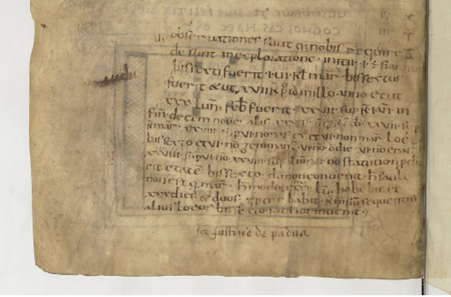
Fig. 1. f. 14v, with Libri’s fraudulent ex-libris at the bottom.
This little codex is so interesting because it is filled to the brim with the kind of texts that straddle the border between calendrical and medical knowledge already briefly mentioned by Meg Leja and Carine van Rhijn in (MMOTM 2 and 5). Its main topic is computus –the medieval discipline of knowledge devoted to the calculation of the date of easter and all its adjacent mathematical problems, astronomical cycles, and calendrical peculiarities.[3] Among things like a tidal table, numerous computistical argumenta, a poem on the names of the weekdays and excerpts from Bede on finger-reckoning, however, we find many examples where this type of calendrical learning can also be valuable in health-related circumstances.


Fig. 2. Left: Sphere of Pythagoras (Ratio spere phtagor [sic] philosophi). f. 7v. Right: f. 14r Tetragonus subiectus (De ragono [sic] subiecto).
The most visually striking examples are the two onomantic devices, a version of what is often called the Sphere of Life and Death on f. 7v and the rectangular diagram known as the Tetragonus subiectus on f. 14r. [4] While they are clearly different texts, both are attributed to Pythagoras. It is claimed they can predict whether someone who has fallen sick will survive and both employ a similar onomantic calculation. They work as follows: first, you add up the numerical value of the letters in a subject’s name using the information given in the alphabetical column to the left. You then add the day of the lunar month on which the person fell ill. This synodic cycle stands at the core of many computistical calculations, and anyone reading a computus handbook could be expected to have a working knowledge of such lunar reckoning. The resulting number is divided by 30 (although in other versions of the Tetragonus this is often 29). You must then find the section of the spherical or rectangular diagram where the remainder of this division is located. In the case of the Sphere of Life and Death, this is a simple two-way division, with numbers above the middle line showing the subject lives, while below the line, they die. The Tetragonus adds more complexity by dividing the numbers above and below the horizontal middle line into three vertical columns. A number in the vertical middle column above the line means a quick recovery, while below it predicts a quick death. If the number is in the left or right column, the subject will either slowly recover if it is above the line or perish after a long struggle if you find it below the line. Both texts state that you may use them to ask any other question you wish (though clearly, these can only have binary positive or negative answers). The sphere on f. 7v, however, adds a whole new use-case by which you can calculate the outcome of a fight by adding the value of the weekday, given in a list at the bottom of the text, and the specific hour on which it occurs.
On ff. 10v-12r, we find a lunary,[5] another text that uses the lunar month. It is different from the lunaria previously featured on this blog. This so-called general lunary combines many repeating predictions, not all health-related, for the 30 days of a lunation into one text. The full Moon (luna XIIII), the text states, for example, “is good for giving and receiving whatever you wish, for sailing, for travelling by foot, and for catching fish in nets and whoever falls sick will be healed, whoever flees will be captured, and whoever is born will be full of life”.
Two texts immediately afterwards (f. 12r) list unlucky days of which to beware. The first introduces the Egyptian Days (Incipiunt dies Egyptiali), listing 24 days (two in each month) on which you should undertake no actions. This explicitly includes the treatment of bloodletting “on both man and livestock” but also non-medical acts like travelling and planting in vineyards. We find Egyptian Days in various forms in all sorts of early medieval manuscripts. They show up as simple mentions in calendars, as mnemonic poems and, as we see here, as standalone prose texts. The thematically similar second text on this page often accompanies them. This text is sometimes known in scholarship as the Three Critical Mondays, but here, it also receives the Egyptian moniker. This text lists three Mondays in the year that should be observed above all others: the first after 25 March, 1 August, and 31 December. Its warnings are more strictly medical. If, for instance, you bleed man or cattle on these three days, it tells us they will die within four days, while those who drink potions will die before the fifteenth day. Even those born on these days will die a painful and toilsome death. Only two statements intimate an underlying rationale for these injunctions. One hints at humoral theory by noting that on the last Monday of December, “all veins are full”. The other is more biblical in its explanation: “These Egyptian days are cursed like the people of Egypt with Pharaoh”.
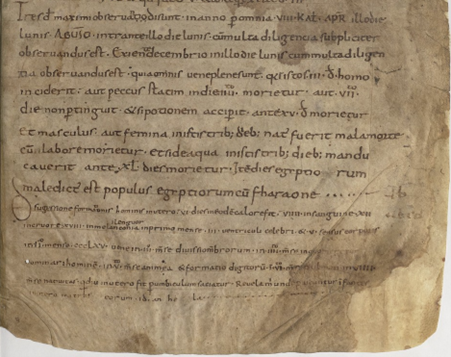
Fig 3. f. 12r: The text on the Three Critical Mondays with an added note on the development of the foetus.
These texts invite us to ask where the early medieval makers and users of this booklet believed medical knowledge ended and other fields of learning began. One slightly later scribe certainly seems to have understood these texts as thematically medical when he added a small note on the developments of the parts of the human body in the uterus to the bottom of f. 12r. But then what do we make of the text on the folio’s verso explaining the meaning of gales on the twelve nights of Christmas.[6] Is the statement that “if there is wind on the third night, orphans and women will perish” health-related? Is this perhaps an implicit reference to the miasma theory? Or does the fact that wind on the following night predicts that bread will not be abundant suggest that these forecasts should be seen more as interpretations of divine signs than medical advice? Where is the line between providential portents and medically helpful information in a worldview where the Moon can influence both travels and sickness and names can influence the outcome of fights and your chance of surviving an illness?

Fig. 4. f. 12v: Prognostic for winds on the twelve nights of Christmas.
[1] Anna Dorofeeva, Reading Nature in the Early Middle Ages. Writing, Language, and Creation in the Latin Physiologus, ca. 700-1000 (Leeds 2023) pp. 187-192; David Juste, Catalogus codicum astrologorum latinorum. II. Les manuscrits astrologiques latins conservés à la Bibliothèque nationale de France à Paris (Paris 2015) pp. 267-268; Bernhard Bischoff, Katalog der festländischen Handschriften des neunten Jahrhunderts (mit ausnahme der wisigotischen) vol. 3. Padua – Zwickau, aus dem Nachlaß hg. von Birgit Ebersperger (Wiesbaden 2014) p. 242; Ernest Wickersheimers, Manuscrit latins de médecine du haut moyen age dans les Bibliothèques de France (Paris 1966) pp. 140-142. Some have placed the origin of this manuscript in Brittany based on the Breton glosses on ff. 6r-7r and 12r. Jacopo Bisagni argues it to be more likely that it was created at Fleury but that at least one of the scribes working on this manuscript was a Breton or working from a Breton exemplar. Jacopo Bisagni, “Paris, BnF, MS NAL 1616”, A Descriptive Handlist of Breton Manuscripts, c. AD 780-1100 (https://ircabritt.nuigalway.ie/handlist/catalogue/170).
[2] Marco Mostert, The library of Fleury; a provisional list of manuscripts (Hilversum 1989) pp. 243-244; Léopold Delisle, Catalogue des manuscrits des fonds Libri et Barrois (Paris 1888) 76-78.
[3] Faith Wallis, “Medicine in medieval calendar manuscripts”, in: Margeret R. Schleissner (ed.). Manuscript Sources of Medieval Medicine. A Book of Essays (New York 1995) pp. 105-143.
[4] Joanne Edge, Onomantic Divination in Late Medieval Britain. Questioning Life, Predicting Death (York 2024) pp. 59-75; Roy M. Liuzza, “The Sphere of Life and Death; Time, Medicine and the Visual Imagination”, In: Katherine O’Brien O’Keeffe and Andy Orchard (eds.), Latin Learning and English Lore. Studies in Anglo-Saxon Literature for Michael Lapidge, vol. 2 (Toronto/Buffalo, NY/London 2005) pp. 28-52.
[5] Edited in: Emanuel Svenberg, Lunaria et Zodiologia Latina (Göteborg 1963) pp. 23-29.
[6] Marilina Cesario, “The Shining of the Sun in the Twelve Nights of Christmas”, in: Stuart J. McWilliams (ed.), Saints and scholars: new perspective on Anglo-Saxon literature and culture in honour of Hugh Magennis (Cambridge 2012) pp. 195-212, at p. 207.