Tim Hertogh writes…
This manuscript of the month, Würzburg, Universitätsbibliothek, M. p. th. f. 46, is more than a witness to medieval medicine; its parchment may have been used as medicine itself. The manuscript’s main text, dating from the early ninth century, contains computistic tables, annals, and Bede’s De Ratione Temporum.[1] For medical material, we must turn to the margins, where we find a few incantations and a Sphere of Life and Death.[2] Among these marginal notes, a short and easily overlooked list of names deserves a closer look.
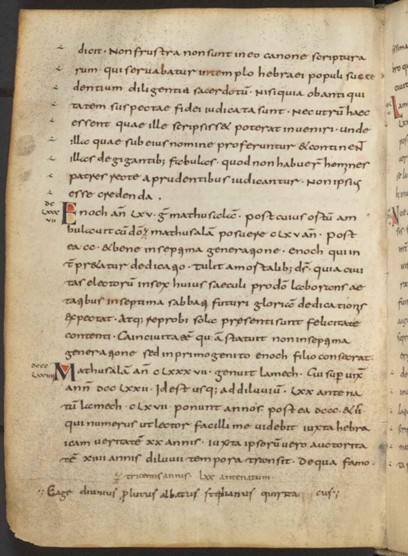
Figure 1: Würzburg, Universitätsbibliothek, M. p. th. f. 46, fol. 98v with the names of the seven sleepers in its lower margin (digitised image available here: https://handschriftenportal.de/search?hspobjectid=HSP-e89dd6c0-1909-3ef5-9810-3b28d1945aa9).
The list was recorded in the lower margin of fol. 98v during the tenth century and reads as follows: “Eage, Diunius, Prolutus, Albatus, Stephanus, Quirita [effaced] cus”. It is a somewhat garbled enumeration of the names of the Seven Sleepers of Ephesus. These are Christian saints who, according to authors like Gregory of Tours and Jacobus de Voragine, miraculously fell asleep inside a cave during a time of persecution and awoke centuries later, unharmed and still faithful. In the medieval Christian and Islamic worlds, these Seven Sleepers became popular authorities to record on different objects for a range of practical, often medical, purposes.[3]
Consider, for instance, the following two examples from ca. 1100 found in the Mülinen Rotulus:
So that a sleeping woman, interrogated, tells the truth about adultery. Aiohel, Deomedius, Eugenius, Probatus, Sabatus, Stephanus, Quiriacus. Put these names, written on a virgin piece parchment, between her breasts when she is asleep and she will mention all those with whom she has committed adultery.[4]
For a fever. Write these names on a host and give it to eat: Maximianus, Malchus, Marcianus, Dyonisius, Iohannes, Serapion, Constantinus. And do this for three days and give it on an empty stomach.[5]
As we can see here, different traditions of the names of the Seven Sleepers were instructed to be written down on different objects and then placed between breasts or eaten in order to resolve certain problems. Could it be possible that our unassuming string of words had a similar purpose?
As Don Skemer has noted, the margins of medieval manuscripts could be used to produce amulets, that is, objects that were worn or otherwise positioned for protection, healing, and other practical purposes. In fact, when travelling to the Abbey of Monte Cassino, the fourteenth-century humanist Giovanni Boccaccio was horrified to find out that the Cassinese monks cut up their manuscripts to produce amulets from their margins that they would sell to women.[6] Could our list of names be evidence of a similar practice?
If we consult the wider manuscript, it becomes clear that several strips of parchment similar to space in which the names of the Seven Sleepers were recorded have indeed been removed.[7] These cuts are scattered throughout the manuscript, do not interfere with the main text, and do not appear to reflect a systematic effort to reduce the size of the manuscript. Rather, it seems that these cuts were made to produce short useful texts from available parchment.

Figure 2: Würzburg, Universitätsbibliothek, M. p. th. f. 46, fol. 5r with its lower margin removed.
This string of names does not stand on its own. In a recent article, I argue that the Old High German Lorscher Bienensegen, an incantation for bees from the tenth century, was recorded in the lower margin of an older manuscript for similar purposes. As with our example of the Seven Sleepers, texts like this bee incantation are also known to have been intended for use as amulets, and its manuscript is likewise missing several cleanly removed strips of parchment.[8]
It is probable that these cases are not unique. Whenever I discuss the idea of possible “amulet manuscripts” with other medievalists, more cases keep popping up.[9] And it seems likely that incantations and the names of the Seven Sleepers were not the only texts recorded onto such strips of parchment for the purposes of protection, healing, or even finding out if your wife had committed adultery. Perhaps some of the liturgical phrases, citations from the Bible, and names of saints that we find in manuscript margins were intended to be used in a similar way. Equally, it might be possible that some of the numerous missing margins in medieval manuscripts were once removed to create amulets.
In short, I would suggest that the names for the Seven Sleepers recorded into the margin of Würzburg, Universitätsbibliothek, M. p. th. f. 46 were once meant to be cut out and used as an amulet, perhaps to cure fever or to expose an unfaithful spouse. In this way, an unassuming list of names in a margin not only tells us something about early medieval medicine, but it may also provide direct evidence for its practice.
For more on “amulet manuscripts”, see: Tim Hertogh, “The Lorscher Bienensegen is an Amulet: Using Manuscript Margins to Make Amulets,” Manuscript and Text Cultures vol. 3, no. 1 (2024), 160–174. https://mtc-journal.org/index.php/mtc/article/view/59
******
[1] Bernhard Bischoff, Katalog der festländischen Handschriften des neunten Jahrhunderts (mit Ausnahme der wisigotischen), 3 vols. (Harrassowitz, 1998–2014), no. 7484. The manuscript is #192 of the CEMLM-handlist. I thank Claire Burridge for introducing me to the manuscript.
[2] For incantations concerning childbirth, see fols 20v-21r, for the Sphere, see fol. 149r.
[3] For some interesting examples, see Lea Olsan, “Writing on the Hand in Ink: A Late Medieval Innovation in Fever Charms in England,” Incantatio. An International Journal on Charms, Charmers and Charming 7 (2018), 9-45.
[4] Bern, Burgerbibliothek, Cod. 803, r180. “Ut mulier dormiens interroganti verum dicat de adulterio. Aiohel. Deomedius. Eugenius, Probatus, Sabatus, Stephanus, Quiriacus. Hęc nomina scripta in carta virginea inter mamillas pone dormienti, omnes adulteros nominat.” For more on the manuscript, see my earlier blogpost https://cemlm.wp.st-andrews.ac.uk/2024/11/24/mmotm-11-the-rotulus-von-mulinen/
[5] Bern, Burgerbibliothek, Cod. 803, r137. “Ad febrem. Scribe hęc nomina in una oblatione et da ad manducandum: Maximianus, Malchus, Marcianus, Dyonisius, Iohannes, Serapion, Constantinus. Et hoc fac per III dies et ieiuno da.”
[6] Don Skemer, Binding Words: Textual Amulets in the Middle Ages (University Park: Pennsylvania State Uni-
versity Press, 2006), 129.
[7] Fols 5, 9, 18, 35, 123, 124, 144, and 145 are missing such strips from their lower margins.
[8] Tim Hertogh, “The Lorscher Bienensegen is an Amulet: Using Manuscript Margins to Make Amulets,” Manuscript and Text Cultures, vol. 3, no. 1 (2024), 160–174. https://mtc-journal.org/index.php/mtc/article/view/59
[9] See, for instance, Arthur Westwell, “Prognostication, Malediction, Memory and the Ordering of Time: The Additions in a Liturgical and Computistical Manuscript from Sens Cathedral,” Scrineum 21.2 (2024), 83-118, at 110.