Tim Hertogh writes…
This month’s manuscript is the so-called Rotulus von Mülinen, a unique six-meter-long (mostly) medical scroll that not only plays an important role in my PhD research but that will soon have a new edition and translation – the first in CEMLM’s series.[1] Completed in several phases around the year 1100, and possibly in the monastery of Murbach, it is inscribed on both sides with nearly 500 medical recipes and other practical texts. On its verso side, the manuscript also contains an extensive word list of approximately 2000 entries. The texts in the Rotulus are impressively diverse and range from recipes to treat fevers or swellings to incantations for settling a swarming bee colony and even an amulet to find an adulterer. Recently, I had an opportunity to see the Rotulus in person, and the following piece shares some of my findings.[2]
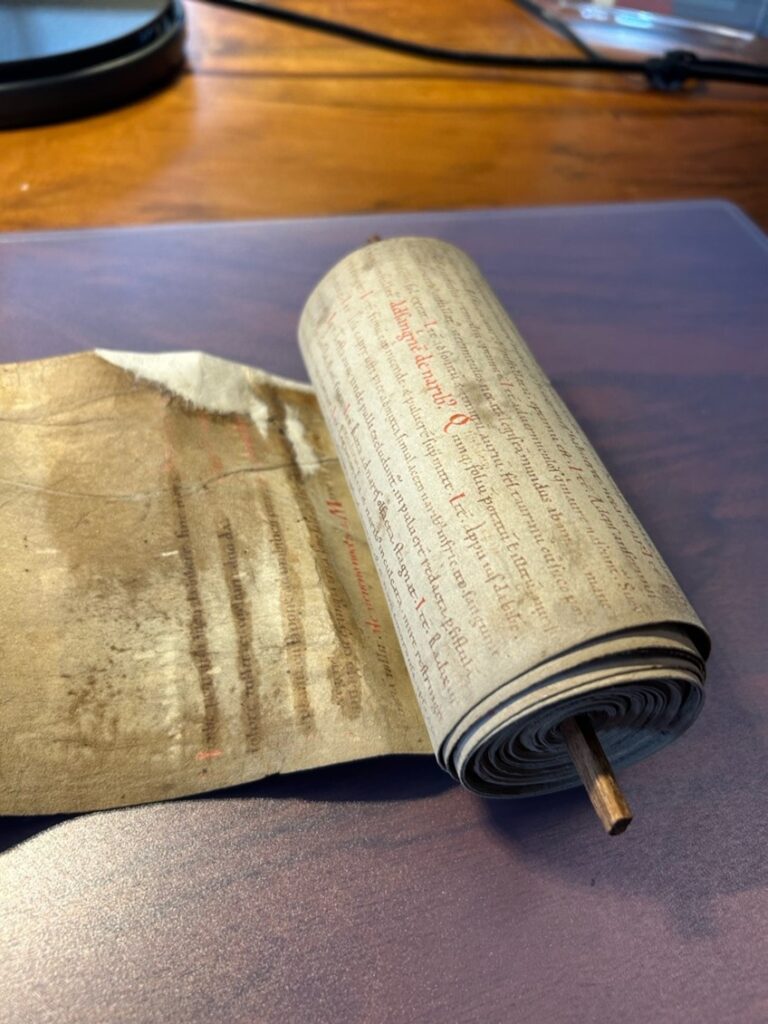
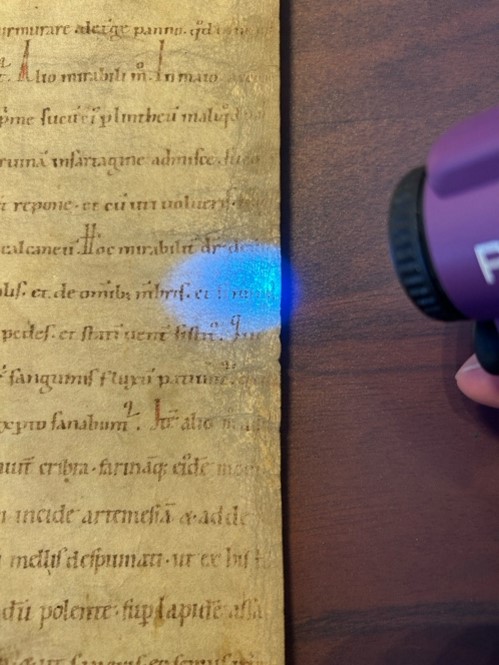
Although there is an excellent digital facsimile available online (see n. 1), it was essential to consult the Rotulus in-person to try to decipher some of the barely legible parts of the scroll. On both sides of the manuscript, parts of the text are faded or cut away. Luckily, several near contemporary manuscripts with parallel sections of recipes have been identified in the process of producing the new edition and translation, and this has meant that we were able to suggest possible readings for many of these gaps. For some other recipes, however, we simply could not find such similar textual witnesses, and, regardless, for those that we did, the manuscript still needed to be checked. Armed with a UV-light from the Burgerbibliothek, my task was to try to fill the remaining gaps in our transcription.
Take, for instance, a recipe on the recto side of the scroll that claims to purge the belly, in which some words were too faded to read. The opening lines read: “In May, take the herb soapwort and, crushing it, squeeze out its juice with a linen cloth into some vessel, and dissolve it into very old lard. Mix it in a frying pan, rubbing the juice well between the hands and put it back, and when you want to use it, smear around the belly button, and under the heels of the feet.”[3] The following lines, however, had several gaps due to faded words. By using the UV-light, it became possible to decipher these sections and understand the rest of the recipe. First, I was able to make out what appears to be the word deducere, which reveals that the treatment was intended to “reduce” harmful humours from the joints, and from all limbs. This efficacy was further explained by solving the following gap, where it now became possible to read the word nimis (see Figure 2) revealing that if “too many” humours are reduced, “you put your feet in cold water, and your belly will be better immediately.”
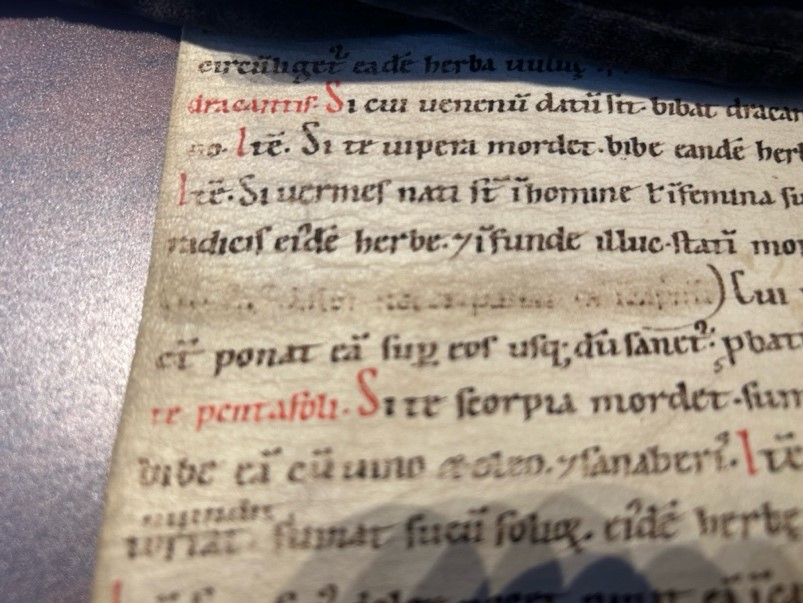
Studying the Rotulus in person also allowed me to recover a line of text that an earlier reader attempted to erase. Located on the lower part of the recto side of the scroll, this line was scratched out, creating an empty space in one of the entries on the virtues of the herb Erchantilla. It became possible to see that this line reads: Cui ficus dolor nocet, panat eam in caprinum (“The person who suffers from haemorrhoid pain should put it in goat’s milk”).[4] The reason that this line was deleted can be understood by looking three lines further down the scroll, where the complete entry against haemorrhoid pain reads: Item. Cui ficus dolor nocet, panat eam in caprinum lac et sic ea utatur III dies. Sanat. (“Likewise. The person who suffers from haemorrhoid pain should put it in goat’s milk and use it like this for three days. It heals.”)[5] This simple error can reveal important information about how the Rotulus was produced. It appears that we are looking at a corrected Augensprung, or “eye-jump”, that is, a line-skipping error madeby a scribe who was copying their text from an exemplar. When the scribe realised their mistake, it appears that they first indicated this by writing down the bracket that you can see on the right of the erasure (see Figure 3). Perhaps the same scribe or a later reader then scratched out the entire wrong entry.
Filling the gaps in the transcription was not the only way in which seeing the Rotulus in person helped me to understand it better. Scholars have long questioned why the Rotulus was produced as a scroll rather than as a codex. For instance, Lucille Pinto proposed that someone might have hung the entire manuscript on the walls of an infirmary, whereas Walter Henzen suggested that it may have had something to do with “magic”.[6] Working with the Rotulus in person helped me to think more about how someone could have used it. To my surprise, the Rotulus was much sturdier, much more compact and much more navigable than I expected. After working with the scroll online for a few years, it was not difficult to find the entries that I wanted to see. By rolling down the bottom while rolling up the top of the scroll in the same pace, it was never necessary to unfold the entire six meters. It was relatively easy to find the clusters of remedies for specific conditions and lay those out on the table. With that in mind, it does not seem entirely impossible that the Rotulus was a handy and portable manuscript, perhaps a text consulted by a medical practitioner to help people with their haemorrhoids, adulterous spouses or superfluous humours.
Ultimately, more research is needed into this fascinating manuscript, and we hope that our edition and translation will help make this possible. Stay tuned for updates!
[1] Bern, Burgerbibliothek, Cod. 803. The Rotulus von Mülinen is available online: https://e-codices.ch/en/list/one/bbb/0803 (consulted 11-13-2024). At present, the most complete work on the manuscript, as well as a trancription, can be found in Norbert Kössinger, Schriftfollen. Untersuchungen zu deutschsprachigen und mittelniederländischen Rotuli. Münchener Texte und Untersuchungen zur deutschen Literatur des Mittelalters (München, 2020), 86-182.
[2] I should like to thank Florian Mittenhuber of the Bern Burgerbiliothek for allowing me to consult the manuscript in-person.
[3] We try to navigate the Rotulus by entries. This is entry <r18.>, meaning that it is the eighteenth entry on the recto side of the scroll. In the following transcription, the brackets indicate letters that have been supplied thanks to the UV-light, and the question marks indicate where I am still not entirely certain of the text. “Alio mirabili modo. In maio accipe herbam lanariam et contundens, exprime sucum eius per lintheum in aliquod vas, deinde resolvens veterrimam arvinam. In sartagine admisce, suco illo inter manus bene fricando et repone, et cum uti volueris unge circa umbilicus, et sub pedibus calcaneum. Hoc mirabiliter dicitur de[duc?]ere noxios humores de articulis, et de omnibus membris, et si [nimis] deducitur, pones in aquam frigidam pedes, et statim venter sistitur. Qui dissenterici dicuntur vel qui per ventrem sanguinis fluxum patiuntur, [qui api?]um in ovo triduo accipiant, experto sanabuntur.”
[4] This is entry <r200.> “(Cui ficus dolor nocet, panat eam in caprinum). Item. Cui pedes tumescent ponat eam super eos usque dum sanetur, probatum est.”
[5] <r203.>
[6] Lucille B. Pinto, ‘Medical science and superstition: a report on a unique medical scroll of the eleventh-twelfth century’, Manuscripta 17 (1973), pp. 12-21; Walter Henzen, ‘Der Rotulus von Mülinen. Codex 803 der Burgerbibliothek Bern’, in: Maria Bindschedler and Paul Zinsli eds, Geschichte, Deutung, Kritik: Literaturwissenschaftliche Beiträge dargebracht zum 65. Geburtstag Werner Kohlschmidts (Bern, 1969), 13-27.