Carine van Rhijn writes…
The project reached an important milestone this summer: at the end of June, we published the first version of the Handlist on this website. Of course, we are happy and proud that it is there, and we really hope that people will pick it up and find interesting material in it. To complement its release, there will be an article out soon in Early Science and Medicine. This is how we thought to launch the List to our colleagues.
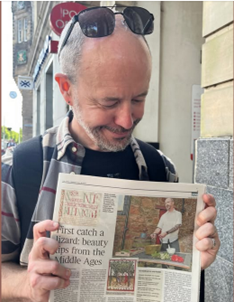
In contrast, we did not think so much about the Handlist’s release in relation to wider audiences. After all, how exciting is this list to non-specialists? All that changed, however, when we were getting ready to publish: James had a chat with the press officer at St Andrews, who saw potential immediately and wrote a press release (here: https://news.st-andrews.ac.uk/archive/lizard-shampoo-and-spheres-of-death-new-work-sheds-light-on-dark-age-medicine/) – and before we knew it, the project got attention in The Times, featuring a big picture of James, his mother’s cauldron, and assorted plants in his own back garden (here, with a paywall: https://www.thetimes.com/uk/history/article/medieval-health-wellness-fads-lizard-shampoo-3smd5b3vj). Amazing!
Meanwhile, the Utrecht press officer issued a Dutch article (here: https://www.uu.nl/nieuws/hagedissenshampoo-in-een-priesterboek-middeleeuwse-medische-teksten-op-onverwachte-plekken), and after the American 4th of July break, their Binghamton colleague also published a press release (here: https://www.binghamton.edu/news/story/5669/medieval-medicine-was-smarter-than-you-think-and-weirdly-similar-to-tiktok-trends). Especially after this last article had appeared, things took off in ways we never expected.
It is now a little over a month later, and the news has produced more than 110 articles in 34 different countries and over a dozen languages. Wide audience reached: mission accomplished! Thanks to the success of the Binghamton article, Meg gets quoted in (amongst others) Arabic, Estonian, Indonesian, and Russian. Websites dedicated to popular science, but also to off-the-grid living, modern pharmacy, and alternative wellness picked up the news. Somebody made a Youtube video [https://www.youtube.com/watch?v=9w7dXxhOcNY], and a French science website did an article plus video after an interview [https://www.sciencesetavenir.fr/archeo-paleo/archeologie/un-catalogue-de-manuscrits-bouleverse-notre-vision-de-la-medecine-au-debut-du-moyen-age_187302]. The stream of news articles has meanwhile slowed down to a trickle, but it has not stopped.

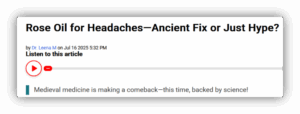
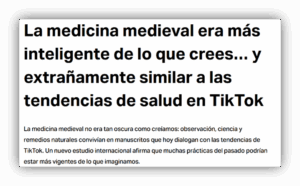
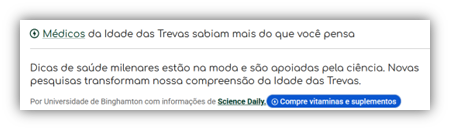
But what exactly is the news in this story or, put differently, what is it that our wider audience heard? What started as ‘we have created a handlist with 198 non-medical pre-1000 manuscripts containing medical material’ was first transformed by press officers into something more newsworthy, after which the various media outlets did their own and rather different things with it. As a historian interested in travelling knowledge, I found it fascinating to see this process unfold in real time.[1] So, how did the Handlist ‘land’ in the worldwide press, and how much of the story was retained in the process? Three observations.
- Unsurprisingly, all the clichés about the Dark Ages and its superstitious, stagnant, credulous, etc. culture are, sadly, alive and well. However, many news items want to debunk this idea: early medieval medicine is more intelligent than thought; early medieval people were more interested in health, beauty, and medicine than once thought. They were not stupid, they tried to solve their every-day problems. Clearly this is a message that cannot be repeated enough.
- The one element that did really well is the title (but less the content) of the Binghamton press release: “Medieval medicine is smarter than you think – and weirdly similar to TikTok trends”. This TikTok-comparison got everywhere. The message did get a bit mixed-up in some cases: ‘1,000-year-old health hacks are trending – and backed by science’ [expotobi.com]. For the record, our research does not back any TikTok trend, and the pharmaceutical recipes, healing incantations, and other material contained within the Handlist should not be tried at home (another message that cannot be repeated enough evidently). The main point here is that early medieval medicine is not obscure, disgusting, and weird, but recognisable to TikTok-followers today.
- The manuscripts did really well, too. The various press officers made sure that manuscript images were part of the news from the very beginning, and pictures of early medieval codices were used in many articles. Others added their own imagined medieval doctors, which merits a study in itself…


So, how well did the news about the Handlist travel? It depends. The Handlist itself was not very prominent in nearly all of these news items. Some mentioned a catalogue, but very few provided their readers with the link. A mention of the ‘198 manuscripts’ turns up here and there, as does the idea that this material was not the result of senseless copying by early medieval people who had no clue. What travelled best, however, were the clever frames of the press releases – so thank you Ruth, Renée, and John for spreading the news!
[1] A very interesting and highly readable introduction: Mary S. Morgan, ‘Travelling facts’, in: Peter Howlett and Mary S. Morgan, How well do facts travel? The dissemination of reliable knowledge (Cambridge: Cambridge University Press, 2012), pp. 3-39.