James Palmer writes…
Who likes scruffy manuscripts?
My choice for MOTM is this little booklet of medicine from the late eighth/ early ninth century. In its paltry eight pages it offers us so much and so little – something to stimulate speculation over what it represents and not much more. It is lovely.
Part of the fun lies in how it is written. The Codices latini antiquiores record notes the script is “partly a careful minuscule, partly a careless late uncial.” You can see what Lowe meant.
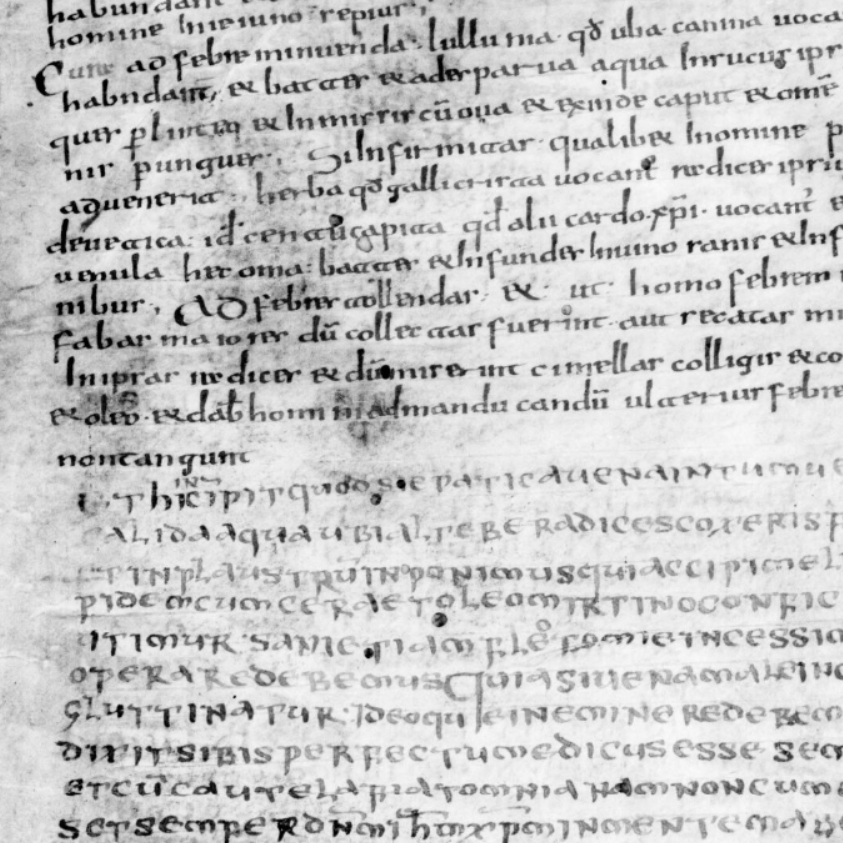
Fig. 1: “Careless”
But let’s not get too judgemental. Aesthetics aside, the “careless” scribe is still well-trained and capable of producing a good legible book. And we don’t know anything about the two (or more) scribes. They could have been monks but I also like to imagine they were colleagues working in medicine together, building up a handbook over the years. Maybe they were literature professionals, just not professional scribes.
Where might this team have gone about their work? It was found in the bindings of a book in Le Puy in 1875 so “Southern France” is an option. CLA notes the use of a “Visigothic” letter t which would support that – although it is also sometimes mixed with a Beneventan form so E. A. Lowe and later Bernhard Bischoff didn’t rule out Northern Italy either.[1] It shares a short receipt for treating scabies with a near-contemporary manuscript from Bourges, if that sways anyone.[2]
Wherever they were, the pages offer an intriguing little collection of short texts. There are some cures for fevers. A few recipes including one for if you can’t get the best aromatics. Some others for miscellaneous conditions. There’s a little bit of bloodletting. A common text on weights and measures. Generally practical stuff, in other words.
Exactly what is going on is a bit confused because the pages are not bound in the right order. A text billed as “The Letter of Hippocrates on Human Nature” – better known as the Gynaecea attributed to Vindicianus – starts on fol. 3v, continues merrily on the next two pages, but then you have to flick back to fol. 2r and 2v for the ending.

Fig. 2: “Mistaken Identity”
It also doesn’t help that the form of the text bears no resemblance to the many other known versions of this text. But its “odd” spellings and syntax tells us important things too, about how much medical knowledge mutated into vernacular forms – a living, evolving body of wisdom transmitted through a living, evolving language. Medicine here was not the preserve of a conservative book elite by any means (not that that was ever really a thing). It was something people talked about.[3]
As we only have these four sheets, sadly we can’t know if it was once part of a much larger compendium. Contents-wise, it is very much in-keeping with the kind of material we find all over. That itself is interesting because, what we are finding, is that a lot medical knowledge is just widespread in the Latin West without much evidence of transmission bottlenecks or loss from late antiquity. Looking at a our manuscript you could reasonably wonder how many more medical books were cast aside or torn apart because they were scruffy everyday things and/ or because they ended up owned by milieux less interested than we are in preservation for preservation’s sake. To someone, this was much more valuable and interesting than it seemed to many people in later generations. With a bit of imagination, we can start to explore that lost world a little.
[1] B. Bischoff, Katalog der festländischen Handschriften des neunten Jahrhunderts, vol 3 (Wiesbaden, 2014), no. 5063.
[2] CLA also note affinities with the important manuscript Glasgow, University Library, Hunterian 96, which is another that splits opinions on France vs Italy. I sat with that manuscript in front of me and the digitisation of NAL 203 on a screen and… well, I’m sure he’s right. It didn’t look that strikingly similar to me but I’m not a palaeographer.
[3] On the value of medical sources for studying vernacular Latin see J. N. Adams, The Regional Diversification of Latin, 200BC-AD600 (Cambridge, 2007).