Claire Burridge writes…
Following our summer break, we’re resuming our monthly posts with a recap of CEMLM’s busy summer. Just as in 2023 and 2024, we combined the International Medieval Congress (IMC) with our annual meeting in St Andrews – and we have lots to report!
Let’s begin with the IMC. CEMLM organised two sessions under the banner ‘New Directions in the Study of Early Medieval Latin Medicine’. The first, ‘Temporal Frameworks of Preventative Care’, took inspiration from this year’s general theme at the IMC, ‘temporalities’, and featured papers from Meg Leja, James Palmer, and Jeff Doolittle.
James got us started with ‘The Year in Health in the Carolingian Medical Liber Epistolarum’, introducing a letter collection found in Paris, BnF, MS lat. 11219. James, Meg, and Jeff are currently editing and translating this collection, and its letters present short, introductory treatises on medical theory, ethics, and practice. Many include guidance for how to maintain your health over the course of the year, and these regimens are typically structured according to the seasons or move month-by-month.

James’s paper engaged with questions of timing at many levels. Bede, for example, divides time into three types: natural (e.g. seasons), customary (e.g. months having 30 days) and authoritative (whether established by people or God). Yet James also got us thinking about the layers of time involved in the letter collection itself, from its compilation and translation to the composition of the copy in Paris, BnF, MS lat. 11219 and its later corrections.

Meg then continued to explore regimens in her paper, ‘Month by Month, Year after Year: Temporal Rhythms of Preventative Healthcare’. Here, she examined the ways in which these texts emphasise habits and long-term rhythms, cultivating a ‘style of temporal awareness’. As Meg highlighted, this contrasts with the more individualised approaches to medicine we find in the later Middle Ages – approaches that tend to focus less on the universality of time.

In the final paper of this session, ‘For Not Only Present Afflictions, But Also Future Ones: Temporality and Preventative Medicine in the Early Middle Ages’, Jeff concentrated on a particular compound remedy, the Antidotum Theodoritum, whose manuscript transmission illustrates some of the ways in which understandings of time and seasonality evolved. To date, Jeff has identified more than seventy witnesses to this antidote in over twenty manuscripts. Although each witness is different, collectively, they speak to a shared tradition centred on a core group of ingredients. Interestingly, many variants comment on the treatment’s seasonality (i.e., when to use it), blurring the boundaries between recipes and regimens.
After the morning coffee break, we continued the focus on temporality with our second session, ‘Recipes, Words, and Timing’, and heard papers from Tim Hertogh and Carine van Rhijn, plus a response from Claire Burridge.
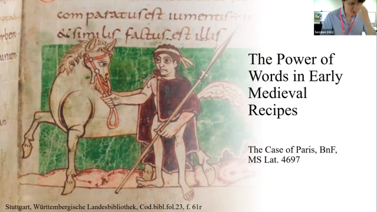
In ‘The Power of Words in Early Medieval Recipes’, Tim focused on a series of treatments that were copied into the margins of Paris, BnF, MS lat. 4697 (a manuscript in the Handlist!). While these additions are not yet fully mapped out, it appears that many concern horses, making it one of the largest surviving collections of horse-related medicine recorded in Latin in the early Middle Ages. Tim’s work underscores the significance of CEMLM’s focus on previously overlooked medical texts, highlighting how we can learn more about early medieval approaches to veterinary medicine by exploring marginal additions.

In the second paper, ‘Predicting Health in Early Medieval Europe, or When Time Is (Not) on Your Side’, Carine turned to medical texts that integrate knowledge about health’s temporal components, asking how time shaped therapeutic possibilities and expectations. Carine argued that, while ‘time sensitive healing’ has a long history, it expanded in the early Middle Ages, and this expansion meant that such material, like lists of Egyptian Days (days that were thought to be unlucky, especially with respect to health-related activities, such as bloodletting) travelled widely and ended up in non-medical manuscripts. In fact, roughly half the entries in the Handlist contain health-related texts with a time element. The widespread diffusion of these texts, and their frequent appearance as additions made to non-medical manuscripts, can shed light on the general interest in, and practical dimensions of, time sensitive healing.
Finally, Claire offered a response to both sessions that focused on the range of temporalities seen throughout the five papers as well as the impact of CEMLM’s work. Time can be seen at many different, often intersecting, levels: ‘natural’ time, for example, could be extended from general timing structures (seasonality, the lunar cycle, etc.) to the individual (lifespans, the length of a disease or, in some cases, disease cycles (e.g., malarial fevers)). Health-related prognostics, dietetic regimens, and other medical texts bring these various levels together, applying universal rhythms to individual lives.
Turning to CEMLM, these papers underlined how the team’s work is helping to make early medieval Latin medicine more accessible, whether by editing and translating known texts, such as the letter collection in Paris, BnF, MS lat. 11219, or by sharing new finds, such as the additions in Paris, BnF, MS lat. 4697. A better grasp of the early medieval material will make it possible to explore continuities and differences with later medieval medical traditions, an exciting research direction touched on by Meg’s and Jeff’s papers. At the same time, by looking at the spread of medical knowledge – and considering ‘medicine’ in very broad terms – we can re-evaluate our assumptions about how and what kinds of information travelled, as well as what this can tell us about the relationship between texts and practices. Bringing all these themes together, the CEMLM papers encourage us to think about the degree to which people familiar with medicine were specialists or generalists and how the early medieval ‘calendrical/computistical mindset’ influenced contemporary understandings of, and approaches to, health and healing.

A few hours after these sessions wrapped up, our team set off for St Andrews! Arriving late on Thursday night, we then had two full days for our annual meeting. Based at the St Andrews Institute of Medieval Studies (see Fig. 6), we immediately jumped into action, tackling points on our lengthy agenda, from big picture items, like publication plans and future goals, to the knitty-gritty of making updates to the handlist. In addition to these group discussions, Meg, James, and Jeff shared an update on their edition and translation of the Liber epistolarum, including particularly challenging transcription puzzles for us to work through together. The second day wrapped up with a focus on the team’s next co-written publication, building on our collaborative article, ‘Early Medieval Medicine: How a New Corpus of Manuscripts Is Transforming the Field’ (2025).

Although we packed a lot of work into these two days, the annual meeting wasn’t without some fun, from team dinners (thanks, James!) to mid-afternoon ice cream breaks (seagull attack not pictured…). While we meet up regularly online throughout the year, being able to work together in-person makes such a difference, and we’re really grateful to everyone behind the scenes who has made this possible. In particular, our thanks go to the Institute for hosting us, the administrative staff for coordinating our travel and accommodation (special shout-out to Audrey Wishart!), and the British Academy for providing the funding. We’re already looking forward to next year!