Claire Burridge writes…
This month, we return to the Bern Burgerbibliothek – the site of our project’s first MotM blog post – to explore the early ninth-century cod. 224. This wonderfully rich manuscript is thought to have been produced in the circle of Theodulf of Orléans, probably at Saint-Mesmin-de-Micy, though various tenth-century additions found within the codex indicate that it relocated to Strasbourg at a fairly early date.[1]

The manuscript primarily contains a large collection of works by Isidore of Seville (ff. 3ra-181va; see Figure 1), including his well-known Etymologiae and De natura rerum. Several short treatises by other authors, such as Gennadius of Marseille and Eucherius of Lyon, appear after this Isidorean assemblage (ff. 181va-193rb), and the manuscript’s final folia contain a series of Latin glossaries (ff. 193va-226vb).
While Isidore covers medical topics in his Etymologiae, devoting an entire book within this encyclopaedia to the subject (Book 4, ‘De medicina’), the manuscript doesn’t appear to contain any other works of a medical nature. However, like so many of the manuscripts included in the CEMLM’s cataloguing project, there’s much more medicine than immediately meets the eye. So, although you won’t find this manuscript included in Augusto Beccaria’s monumental catalogue of early medieval manuscripts containing medical writings, I codici di medicina presalernitano, let’s take a closer look at why cod. 224 should be known more widely within the field.[2]
As mentioned above, a number of tenth-century additions in the manuscript demonstrate that it had moved to Strasbourg by the time these additions were copied (a formulary for charters of manumission, for example, places us in civitatem Strazburc). While the manuscript features a diverse array of tenth-century additions – ranging from the aforementioned formulary to a cluster of six antiphons – there is a particular concentration of medical additions, or, to use my current project’s phrase, ‘medical minitexts’.[3]
The medical minitexts are found within a series of pages in the middle of the manuscript, ff. 73v-75r (see Figure 2-3), pages that cover the final chapters of Book 9 of Isidore’s Etymologiae, ‘De linguis, gentibus, regnis, militia, civibus, affinitatibus’ (‘Languages, nations, reigns, the military, citizens, family relationships’).

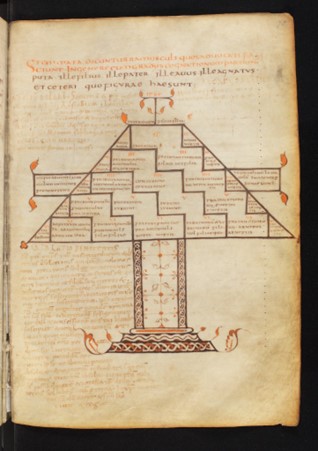
The margins and blank spaces of these four sides of parchment contain a surprisingly large and wide ranging amount of almost entirely medical content. These additions appear to have been written in multiple, roughly contemporary hands:
- First, on f. 73v (Figure 2), a Latin-Old High German glossary of medical terms was added in the margins of a page with a table that addresses family relationships and consanguinity.
- On f. 74r, two medical incantations, a recipe to treat dysentery, and a brief note on weights and measures have been added around another table.
- In contrast, f. 74v was left blank when the manuscript was originally composed and was then filled with minitexts: the first third of the page contains a recipe to treat an abscess of the lungs and an incantation against fever. Two non-medical minitexts make up the rest of the page: another formulary (this one for drafting charters of exchange) is then followed by a blessing.
- Finally, on f. 75v (Figure 3), medical material – in this case, a group of six recipes – surrounds another Isidorean table.
Despite the minuscule, marginal nature of these minitexts, each one offers fascinating insights into the transmission of medical knowledge as well as the evolving uses of individual manuscripts. Consider the medical glossary on f. 73v. It seems to follow the standard format of such texts: the majority of translated terms address plant products (i.e., potential ingredients in medical recipes), though there are a handful of disease names and other medical terms included, too. In almost all cases, a Latin word is paired with its equivalent in a Germanic vernacular: near the top, we see, for example, that the Latin lapacium corresponds to ledecha (sorrel), that the Latin acer corresponds to gundereba (ground ivy), diptamnus to uuizuurz (dittany), and so on.
A quick scan of the whole text suggests that it maintains this structure throughout, but a closer examination reveals that a recipe has been sandwiched in between glossary entries. Roughly halfway down the outer margin, although there is no visual demarcation of a change in the content, a very simple treatment for shins with scabs/sores is recorded: ‘mix old cheese and honey and apply it to the scabby shins for 7 days’ (caseum veterem / et mel mixtum / superpone tibi/is scabiosis / per dies VII.). The glossary entries then resume and, again, show no sign that there has been a change in the type of material being copied into this margin.
As noted above, individual recipes also appear within the minitextual mixtures on ff. 74r-v (though their appearances here are made clear by titles that differentiate between the different types of texts on each page). The final page of this medical minitext group, f. 75r, then consists entirely of simple recipes, ranging from treatments for coughs to head pain (see Figure 3).
They are all written in Latin, though there is one exception. The first ingredient of the second recipe, Ad scabiem (‘For scabby/itchy skin’), is named in the vernacular rather than in Latin and brings us back to the medical glossary: the ingredient, listed here as ledecham, is one of the terms included at the start of the medical glossary just a few pages earlier (lapacium – ledecha)!
Since ledecha is not a term I often encounter in medical recipes (though I have certainly seen lapacium and various orthographic variants), this use, appearing so close to the glossary, seems noteworthy. In the next recipe, an ingredient that was not listed in the glossary, folia fraxini (leaves of ash), has had an interlinear gloss in the vernacular (asc) added above it. This mixing of Latin and vernacular vocabulary strikes me as a significant finding, speaking to the evolving linguistic environment of early medieval western Europe and how recorded medical knowledge responded to these changes.
When considering the wider significance of this minitext, I think it’s also important to reflect on why it might have been added at this point in the manuscript, not least because it might be expected that this collection of medical advice would have been included in the margins of Book 4, ‘De medicina’.
While it’s possible to see the part of Book 9 where the medical minitexts are located as intersecting with health concerns given its focus on family relationships and questions of consanguinity, I would suggest that the particular placement of the minitexts may be less connected to the potential relationship between the content of the base text and additions. Rather, this section of the manuscript offered much more space for writing. The pages with tables, and especially ff. 74r and 75r, created sizable pockets of empty space, and f. 74v had been left entirely blank. These folia thus presented a series of pages with more available space than most other sections of the manuscript, thereby offering an ideal area in which to record a substantial amount of medical knowledge over consecutive folia.
There’s lots more that could be said about these minitexts and cod. 224, but I’ll save these for a future post!
—-
Notes
[1] Bernhard Bischoff, Katalog der festländischen Handschriften des neunten Jahrhunderts (mit Ausnahme der wisigotischen), 3 vols. (Wiesbaden, 1998-2014), I, no. 557 (at p. 118). For more information, see also the online catalogue descriptions on e-codices as well as the recently updated Bern Burgerbibliothek catalogue.
[2] Augusto Beccaria, I codici di medicina del periodo presalernitano (secoli IX, X e XI) (Rome, 1956).
[3] For more on ‘minitexts’, check out the MINiTEXTS research group based at the University of Oslo.