James Palmer writes…
Welcome to the first of our “Medical Manuscript of the Month” blogs from the CEMLM team!
To get things rolling, I have chosen a famous Merovingian (ie Francia pre-751) miscellany that includes two significant sections on medicine. Both sections illustrate something of the untapped potential of medical manuscripts to change the way we think about knowledge in the early Middle Ages.
The manuscript in question is Bern, Burgerbibliothek, MS 611. It is a tricky manuscript to date because it was written by several people over a number of years. Two parts of the manuscript contain dating clauses for years in the 720s, so that gives us an anchor. There is also a short collection of exemplar legal documents that reference Bourges, so maybe the scriptorium had some connection with that city.[1]
As a miscellany, the manuscript covers a range of different subjects. There are bits and pieces on grammar, some riddles, a bestiary (the Physiologus), a text on calendrical calculations (the Computus of 727), a chronicle by Isidore of Seville, and some canon law. There is even the earliest surviving Latin copy of the Apocalypse of Pseudo-Methodius, written in Syriac in c. 691 and somehow already in Aquitaine!
The first significant medical text a work called “On Fevers” attributed to Galen. As a medical text, it is not very exciting or technical. It outlines different kinds of fevers and some ways of treating them. Mostly, it recommends a treatment of opposites, so it you have been working to hard you should rest, if you have been too cold warm up, and so on. It is perhaps important that the text appears in a run of text on grammar, measurement, law and number – i.e. all texts that offer introductions to how things are ordered. The text is underwhelming medicine, but it is great for getting to learn some basics of humoral theory and how the body is also ordered within nature.

At some point, someone has added another little medical text on a spare blank page – this time, a short prognostic text, designed to predict the outcome of illness depending on the age of the moon when you fall ill. Was it on the new moon? Sorry, it’s going to be a long one. Was it the fourth day of the moon? Sorry, looks like you are going to die. Was it the tenth day? You are probably not in any danger. It’s not necessarily there because people believed it and indeed such prognostication was generally looked on with some suspicion. But again, context is important: it is placed in a space after some extracts from an Easter table on the lunar cycle. Our scribe was, once again, mostly interested in different ways nature could be put in order.

The final medical section takes up the final eight folios with a substantial collection of medical recipes and related notes. It is entitled De arte medica, “On the Medical Art.” It hasn’t received a lot of attention as a witness to Merovingian medicine. It is, to be honest, really hard to read even if you know what’s going on. Even when you can, the spelling is… imaginative.
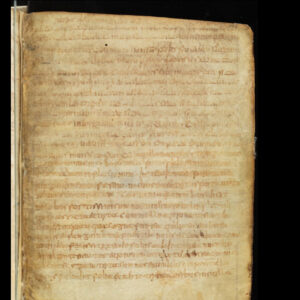
When you do dig into it, it is a lovely little example of people recycling bits of texts in interesting ways. There are bits from a pseudo-Hippocratic Dynamidia, mostly detailing the properties of fruits and nuts. There is the first couple of sentences from the Old Commentary on Hippocrates’ Aphorisms which, maybe because it was theoretical rather than practical medicine, was quickly abandoned. There are extracts from the Merovingian Teraupetica (an assemblage of recipes arranged by illness) and from the herbal of Pseudo-Apuleius (rearranged to that it too is an assemblage of recipes arranged by illness). There is a general purpose recipe it is claimed will cure pretty much anything. There are lots of bits that are as yet unidentified and it has only been very partially catalogued. The scribe clearly had a sizeable medical collection and put together the bits they thought most useful to them. It is, in its own way, another testament to someone “putting things in order.”
There are a lot of implications for the manuscript for the history of Latin medicine… and happily you can read about these soon in a new article by me called “Merovingian Medicine between Practical Art and Philosophy,” coming out Gold Open Access in the journal Traditio this December. I will post a link when I can!
– James T Palmer
[1] Much better than my imprecise thoughts on this see ‘In the circle of the bishop of Bourges: Bern 611 and late Merovingian culture’, in S. Esders, Y. Fox, Y. Hen & L. Sarti (eds.), East and West in the Early Middle Ages: The Merovingian Kingdom in Mediterranean Perspective (Cambridge, 2019), pp. 265-80.