Jeff Doolittle writes…
As we continue our exposition of the many new manuscripts containing medicine identified by the Corpus of Early Medieval Latin Medicine, we have found some wonderful surprises. Our next Manuscript of the Month is Einsiedeln, Stiftsbibliothek, Codex 29 (878), a composite manuscript containing glosses on the Gospels, annals, and a collection of astronomical treatises.[1]

Likely produced at the Benedictine monastery of Einsiedeln, Einsiedeln 29 contains six different codicological units written in various hands. The medical material appears at the end of the second codicological unit (pp. 88-102), dated to the tenth century. This codicological unit primarily contains annalistic texts, including the Annales Heremi (pp. 88-95), originally written at Einsiedeln. At the end of this codicological unit, a slightly later scribe added 21 entries that relate to health and medicine, broadly speaking, on the front and back of a single leaf (pp. 101-102). [2]
This material addresses a range of problems: some entries are medical recipes and treat ailments such as quartan fever, paralysis, impetigo and kidney pain, while others concern cosmetics and several even offer what might be considered “helpful hints”, such as a recipe to keep wine from turning, or a ritual to keep wolves from devouring sheep. There are a handful of veterinary treatments, including three to keep cows healthy and another two for pigs. Some entries combine ritual or charm elements.
Three of the entries are marked with manicules (pointing hand symbols) suggesting later reader engagement. These include Ad uicium podagrae annorum X (“for a ten-year affliction of podagra”), Ad faciem splendidam faciendam (“for making the face beautiful”), and Ut non se mutet uinum (“to keep wine from spoiling”).
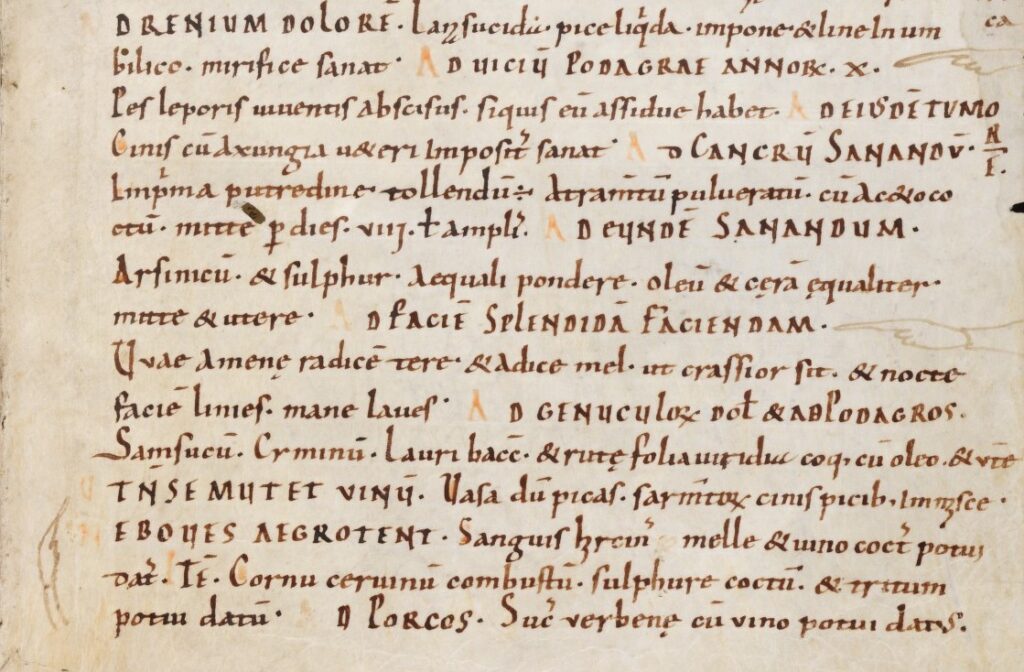
Though wide ranging in application, the recipes themselves are not particularly complex. Most ingredients – such as wormwood (artemisia), betony (uetonica), rosemary (rosmarino), and liquid pitch (pice liquida) – were locally available, though some like pepper (piper) and cumin (cyminum) would have been imported. Instructions are brief, lacking dosages or precise measures. While some tools are mentioned, including a uas (vessel),formal pharmaceutical names are generally absent.
This compact recipe collection is of interest in its own right—particularly as it includes a gloss in Old High German for the herb mercurialis—but it is especially notable for its close alignment with two other Einsiedeln manuscripts likely composed at the same monastery: Einsiedeln Stiftsbibliothek, cod. 319 and Einsiedeln Stiftsbibliothek, cod. 321. [3]
In both Einsiedeln 319 and Einsiedeln 321, brief recipe collections appear in the blank spaces of sections dated to the tenth century. In Einsiedeln 319, a short collection of recipes is found on pp. 280-281 near a tract on penance (pp. 276-280) and a note on Egyptian Days (p. 282) and surrounded by computus texts. [4] In Einsiedeln 321, a slightly longer collection of recipes appears at the end of the codicological unit (pp. 25-26) and, again, follows computus and calendrical texts. [5]
These three recipe collections share five recipes: Ad faciem splendidam faciendam; Ut non se mutet uinum; ne boues aegrotent; ad porcos; and ne lupus pecora noceat. These cosmetic, practical and veterinary recipes are all very similar, suggesting a shared exemplar or perhaps internal copying. The use of manicules further links them: Einsiedeln 319 features manicules pointing to Ad faciem splendidam faciendam, Ut non se mutet uinum and Ut uinum album sit. Einsiedeln 321 contains a single manicule, also pointing to Ad faciem splendidam faciendam.[6]
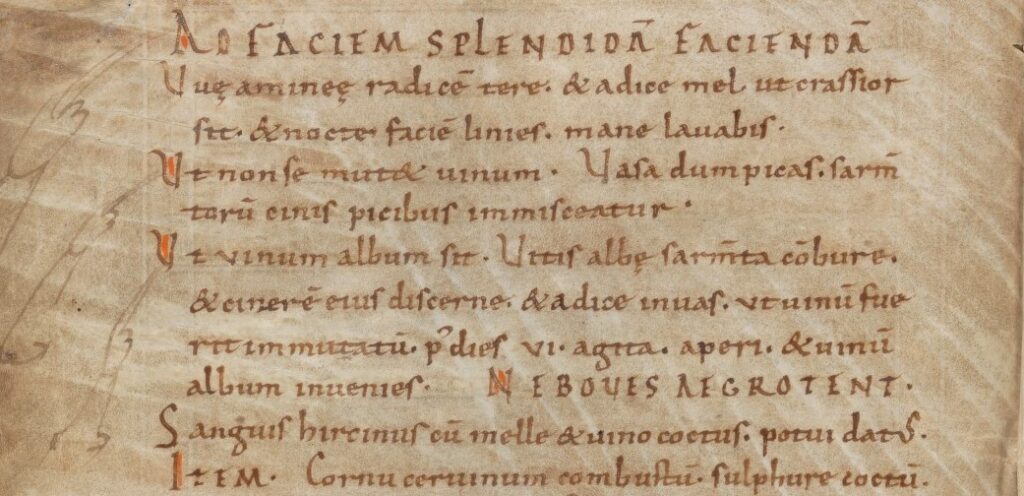

However, despite these similarities, notable differences exist. Einsiedeln 319, much shorter than Einsiedeln 29, contains only cosmetic, practical and veterinary recipes – none for human illness. The recipes here are written in a large blank space and laid out with an eye toward differentiating one from another. Some preparations are given in majuscules with litterae notabiliores dabbed with color.

Einsiedeln 321 features the same core grouping of cosmetic, practical and veterinary recipes, but here, they are crammed into a space at the bottom of p. 26, the verso side of the leaf. These recipes were written by a single scribe and their titles lack majuscules and any use of color. However, on the recto side of that leaf, a different scribe recorded two additional medical preparations that do not appear in the other manuscripts: Ad flegmam incidendam (for dissolving phlegm) and Ad inflationem hydropicorum (for dropsical swelling). There, the use of some color and larger initials, as well as capital letters for pharmaceutical names, helps distinguish the preparations.

These three Einsiedeln manuscripts—Codd. 29, 319, and 321—offer a fascinating window onto how medical, veterinary, and practical knowledge circulated and was preserved in early medieval manuscripts. The similarities between these recipe collections suggest a shared textual tradition, while their differences highlight the varied ways in which medical knowledge was recorded, valued, and accessed. Why were three copies of these recipes made, all within a short time span at Einsiedeln? Why were certain recipes selected and copied across these manuscripts, while others were left out? What does the use of manicules reveal about medieval practices of annotation and reading and perhaps reception of these recipes? And how do these modest, marginal collections fit into the broader story of early medieval Latin medicine? Even small recipe lists, squeezed into the margins or final leaves of codices, can tell us a great deal about the culture and priorities of their compilers and readers.
[1] See the digitized manuscript online at e-codices: https://www.e-codices.unifr.ch/en/list/one/sbe/0029
[2] For standard catalogue description, see that published in 2011 by e-codices by P. Dr. Odo Lang OSB: https://www.e-codices.unifr.ch/en/description/sbe/0029/. See also the older catalogue description by Gabriel Meier, Catalogus codicum manu scriptorum qui in Bibliotheca Monasterii Einsidlensis O.S.B. servantur (Einsiedeln, 1899), pp. 20-22.
[3] See the digitized manuscripts online at e-codices. For Einsiedeln cod. 319, see: https://e-codices.ch/en/sbe/0319/280. For Einsiedeln cod. 321, see https://e-codices.ch/en/sbe/0321/26.
[4] See the standard catalogue description for Einsiedeln Stiftsbibliothek cod. 319 published in 2011 by e-codices by P. Dr. Odo Lang OSB: https://e-codices.ch/en/description/sbe/0319/.
[5] See the catalogue description for Einsiedeln Stiftsbibliothek, cod. 321 published in 2011 by e-codices by P. Dr. Odo Lang OSB: https://e-codices.ch/en/description/sbe/0321/.
[6] For a discussion of some of these recipes with their prominent manicules from Einsiedeln 319, see Jutta Lamminaho, “Verjaag de wolven, klaar de wijn en krijg een stralend gezicht,” in De inventieve middeleeuwen. Praktische kennis en kunde van voor het jaar 1000, ed. Ria Paroubek-Groenewoud and Carine van Rhijn (Hilversum: Verloren, 2023).