Meg Leja writes…
As we draw near to the shortest day of the year, and even those of us who are not particularly attuned to the positioning of the earth relative to the sun pay attention to our cosmic movements for a brief moment, it seemed appropriate to feature a computus manuscript from our CEMLM Handlist.
Vatican, Reg. lat. 1263, known as the Micy computus, is a fairly standard collection of early medieval time-keeping knowledge. It contains pascal tables, a calendar, excerpts from Isidore of Seville’s Etymologies and On the Nature of Things, scientific writings by Bede (On the Reckoning of Time and On the Nature of Things), computistical works by Abbo of Fleury, a piece on finger calculus, and various other materials used to establish the date of Easter and the annual liturgical cycle. Standing at 103 folios, it was produced in the Loire valley, though it may display signs of a connection with Brittany.[1] Most of the manuscript was written by a single hand, in late Caroline minuscule.
It was in the later nineteenth century that Léopold Delisle first argued that the manuscript had been produced at the abbey of Micy-Saint-Mesmin.[2] The calendar (at fols 65r–75r) includes a number of saints’ days related directly to Micy: Maximinus, the patron saint of abbey; Avitus and Carileffus, the saint’s two disciples; and Euspicius, the monastery’s first abbot.[3] Pascal tables on fols 61v–64r offer a terminus ante quem of 1007. Charlotte Denoël has suggested that the codex be situated in the context of Constantine I’s abbacy (which ended in 994), since Constantine was a student of Abbo of Fleury and Gerbert of Aurillac and cultivated a strong interest in astronomy.[4]
The reason for this manuscript being part of our CEMLM Handlist is twofold. First, the calendar mentioned above includes Egyptian Days at the start of each month (though it is important to note that there is no explanation of the significance of these days or of their direct relationship to medicine). Second, the codex contains two spheres of life and death: one at fol. 76v and another at fol. 91r.
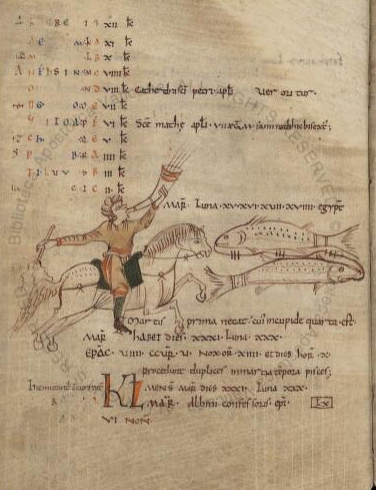
The calendar is worthy of note on its own, as it features detailed illustrations at the head of each month for both the zodiac sign and the (often agricultural) labor appropriate to that time of the year. Thus, for March (fol. 66v), we see a pair of fish for Pisces, and beside that, a rider whipping his horse and blowing a bugle. As James Carson Webster has observed, this image of the monthly “labor” is the first of its kind, with no precedent in late antique models. It contrasts with the labor of pruning that would become the iconography for March in French artistic conventions by the twelfth century.[5]
Immediately following the calendar are a set of rotae (circular diagrams) that cover fols 75r to 77r and visually depict the organization of time and of space. The fourth of these (fol. 76r) is a rota illustrating the relationship among the four elements, four humors, four seasons, and four cardinal points, with the word annus (year) at the center. While this diagram derives from Isidore’s cosmological work, De natura rerum, its themes relate explicitly to the health of the human body and its inherent inclination to be shaped by the changing calendar.[6] Perhaps not coincidentally, then, on the verso of this folio is found the first sphere of life and death—another circular diagram that links numerical calculations (typically adding together a sick person’s name, the lunar day on which he/she fell sick, and the day of the week and then subtracting thirty) with the path toward health or death. The sphere displays the results, with the upper half listing those numbers that indicate life, and the bottom, death. Along the left side of the page are listed the letters of the alphabet with a corresponding numerical value. There is a fairly lengthy set of instructions above the sphere but – intriguingly – these look as though they have may been erased. There is no other page in the manuscript where the script is so worn.

Our second sphere of life and death is located nearly fifteen folios after the first (fol. 91r). In this case, there is no sign of erasure. Instead, we find a big, brightly coloured cross, with the alphabet’s numerical values listed in a circle at the crossbeams, the numbers signifying life and death along the vertical shaft of the cross, and instructions in the horizontal shaft as well as surrounding the cross. The text declares the image to be a sphere of the philosopher Pythagoras, which was described by Apuleius (here Apulegio). The numbers given for the alphabet as well as those signifying life and death are similar, but not identical, to the numbers in the first sphere.

The presence of multiple spheres, with potentially conflicting information, raises a number of questions about how these devices were intended to be used by readers. Were they employed as a healing practice in cases of illness? Were they puzzles for testing a reader’s mathematical skills? Or were they meditative exercises on the nature of human life? Does the erasure of the first sphere’s instructions suggest some attempt to prioritize the second, which has more obvious Christian overtones? Certainly, spheres of life and death are common components within early medieval computus collections, since the focus on mathematical calculations and lunar time fit well with the themes of such collections. However, the sphere in the form of a cross is the only such sphere known to me from before the year 1000 (though perhaps this blog will bring others to light). That point alone makes this particular entry in the Handlist worthy of future study!
[1] See https://ircabritt.nuigalway.ie/handlist/catalogue/202
[2] Léopold Delisle, “Notice sur vingt manuscrits du Vatican,” Bibliothèque de l’École des Chartes 37 (1876): 471–527, at 489–90.
[3] Thomas Head, Hagiography and the Cult of Saints: The Diocese of Orléans, 800–1200 (Cambridge University Press, 1990), 124–25.
[4] Charlotte Denoël, “Imaging Time, Computation and Astronomy: A Computus Collection from Micy-Saint-Mesmin (Vatican, BAV, MS Reg. lat. 1263) and Early Eleventh-Century Illumination in the Loire Region,” in After the Carolingians: Re-defining Manuscript Illumination in the 10th and 11th Centuries, ed. B. Kitzinger and J. O’Driscoll (De Gruyter, 2019), 118–60.
[5] James Carson Webster, The Labors of the Months in Antique and Mediaeval Art to the End of the Twelfth Century (Northwestern University Press, 1938), 50–52, 70.
[6] Barbara Obrist, “Le diagramme isidorien des saisons: Son contenu physique et les représentations figuratives,” Mélanges de l’École française de Rome: Moyen Âge 108 (1996): 95–164.