Jeff Doolittle writes…
While it does not happen often, manuscripts can sometimes change shelfmarks or even locations entirely. These manuscripts, often small fragments, are sometimes hard to trace in the literature as names shift and mistakes are easily repeated. One of the great benefits of preparing the CEMLM Handlist is that it has allowed us to update and expand upon the stories of some of these wandering manuscripts, as well as to see how these manuscripts may be related to others.
One example of this is October’s manuscript of the month, a fragment now known as Champvent, Sammlung Karl Leister, Unnumbered, which is included in our forthcoming CEMLM Handlist. This fragment consists of four leaves only (two bifolia) and was probably produced in Rhaetia (roughly, the area of modern Switzerland) in the late eighth or very early ninth century.[1]
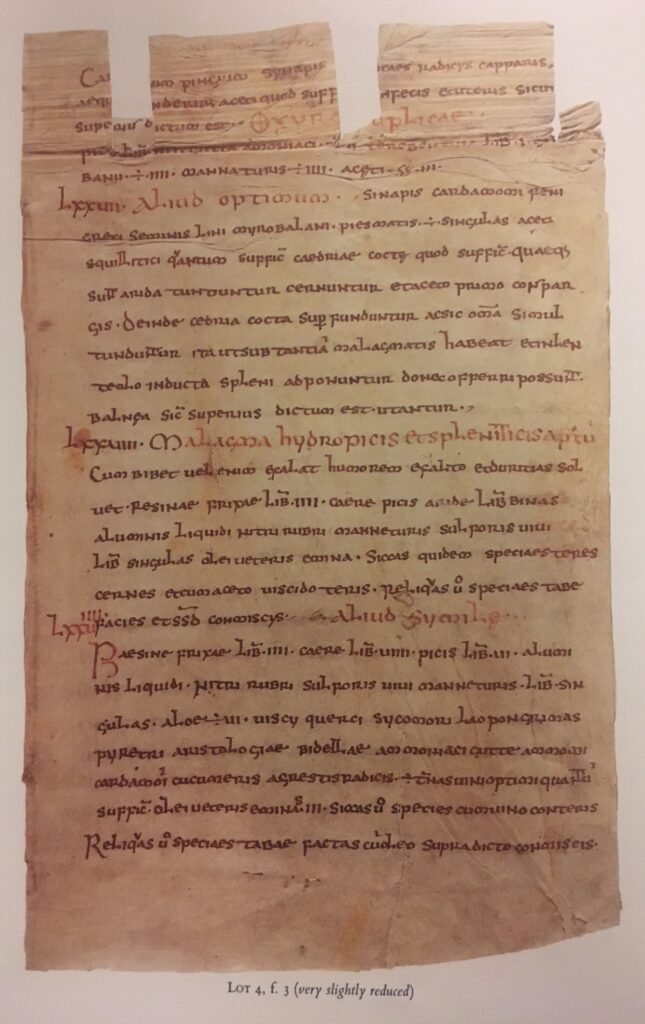
[Image 1: Champvent, Sammlung Karl Leister, Unnumbered. Facsimile of f. 3r as published in Sotheby’s catalogue for the 1982 auction of manuscripts from Donaueschingen.]
The Champvent fragment contains parts of an apparently extensive and organized recipe collection, with recipes numbered 36-60 and 76-90 on each respective bifolium. These recipes have some complexity too; they contain formal pharmaceutical names and indications, and each gives multiple ingredients with some instructions on preparation, indicating that this was more of an antidote collection, or recipes for compound medicines. The recipes have been transcribed by Alban Dold and cover a range of maladies.[2] There are several purges, epithimata, malagmata and plasters, generally grouped with similar preparations, another sign of careful arrangement of contents.
But the fragment has not been in Champvent for very long. Indeed the fragment has only been part of the Sammlung Karl Leister, a private collection in Champvent, Switzerland, since the 1980s. Beccaria had included the Champvent fragment in his catalogue, but back in the 1950s when he worked, the manuscript was in Donaueschingen, part of another large private library, the Fürstlich Fürstenbergische Hofbibliothek.[3] This manuscript, which was eventually assigned the shelfmark MS E.I.10, was then sold by the Hofbibliothek at a Sotheby’s auction in June 1982, part of a larger sale of the manuscripts of Donaueschingen.[4] Through these different libraries and catalogues, no fewer than three different names exist for this fragment.[5]
As interesting as the Champvent fragment is on its own, E.A. Lowe and Bernhard Bischoff argued that it was once part of a much larger early medieval medical compendium. Using paleographical and codicological evidence, E.A. Lowe and Bernhard Bischoff have linked the Champvent fragment with other medical fragments including Munich (Munich, BSB Clm 29684; formerly numbered 29135 and 29136) and Dillingen (Dillingen, Studienbibl. XV fragm. 24) and surmised that they were all part of the same early medieval medical compendium.[6] More recently, Elisabeth Wunderle has suggested that another Dillingen fragment (Dillingen, Studienbibl. XV fragm. 24a) should also be considered a part of this hypothetical codex.[7] Altogether, some fourteen folios of this early medieval codex may survive in these three locations.

[Image 2: Leaf from Dillingen Studienbibliothek, XV fragm. 24a (f. 1r) showing three antidotes, perhaps part of the same codex as the Champvent fragment.]
If these fragments were all part of a single compendium, it was an impressive one, judging from their varied contents. Though it is not yet clear what order the surviving folios would have been in the original manuscript (I have just arranged them alphabetically by shelfmark), the diversity in contents alone is exciting:
- Champvent, Sammlung Karl Leister, unnumbered (4 fols.): Recipe collection of complex compound medicines numbered at least up to 90 (and perhaps many more).[8]
- Dillingen, Studienbibliothek, XV fragm 24 (upper and lower sections of 2 fols): Galen, Ad Glauconem de medendi methodo libri II (including elements of at least chapters 22, 23, and 24)[9]
- Dillingen, Studienbibliothek, XV fragm 24a (2 fols): Antidote collection, including recipes for Antidotum ad […]n[…] omnibus notum; Antidotum poda[…]; Antidotum dia centauriu podagricum; Trociscus podagricus Fylagri dia elleboron appellatus; and Catapotia catartica[10]
- Munich Bayerische Staatsbibliothek, Clm 29684 (6 fols): De pulsibus et urinis (parts of chapters 23 and 31); Fragments of the pseudo-Galenic Liber Tertius (Fragments of chapters 2, 5, 11, and 12); Fragments of Cassius Felix, De Medicina (parts of chapters 1, 16 and 17)[11]
Though the full contents can only be guessed at, the medical texts surviving on just these fourteen folios indicate a volume of some size and complexity. The Champvent fragment together with the Dillingen Fragment 24a reveal the presence of one or more expansive and organized recipe collections. The Dillingen Fragment 24 and the Munich Clm 29684 fragments contain additional specialized medical treatises, including excerpts of Galen’s Therapeutics (Book II) and the pseudo-Galenic treatise known as the Liber Tertius. These contents indicate that the original codex may have been a medical encyclopedia perhaps along the lines of the nearly contemporary Bamberg, Staatsbibliothek cod. med. 1 (s. ix1) or Berlin, Nationalbibliothek, Preussischer Kulturebesitz, cod. Phill. 1790 (s. ix1).

[Image 3: Another likely piece from this original codex. Leaf from Munich, Bayerische Staatsbibliothek Clm 29684 (f. 1r) showing an excerpt of a text known as De pulsibus et urinis.]
But many more questions arise when we consider these four groups of fragments as witnesses of a single medical manuscript. What is the relationship between the numbered recipes in the Champvent fragment and the unnumbered antidotes in the Dillingen 24a fragment? Were they part of a much larger recipe collection as in Montecassino, Archivio dell’Abbazia, cod. 69 (s. ix2) or Glasgow, UL, MS Hunter 96 (s. viii/ix)? Does the presence of Galen’s Book II in Dilllingen 24 and the fragments of the pseudo-Galenic De pulsibus et urinis and the Liber tertius in Munich Clm 29684 indicate the presence of a similar arrangement of medical texts as in Montecassino, Archivio dell’Abbazia, cod. 97 (s. xin) or Wien, Österreichische Nationalbibliothek, cod. 68 (s. x)?
The Champvent fragment along with the other dispersed fragments reveal evidence of a traumatic history, however. At some point in the later Middle Ages, the original codex was dismembered and the individual bifolios which survive today were each recycled as bindings for new books. Yet as destructive as this repurposing of the original codex was, it was also the means for survival for these fragments. The Champvent fragment itself still shows deep cuts that were made to the parchment as it was incorporated into a spine of a new book. Traces of an old hasp of chain can be seen on f. 1 and elsewhere, some surface loss serves as a reminder of where the parchment had been attached and pasted down.
Now that the Champvent fragment’s provenance and updated shelfmark have been included in the forthcoming CEMLM Handlist, it will be easier both to work on answering these questions, as well as to maintain and update an evolving bibliography on the manuscript. This also allows us to incorporate discussions of the Champvent manuscript into future studies of the closely related Munich and Dillingen fragments.
[1] Sotheby Parke Bernet & Co, Catalogue of Twenty Western Illuminated Manuscripts from the Fifth to the Fifteenth Century from the Library at Donaueschingen (London, 1982), pp. 30-33.
[2] See Alban Dold “Donaueschinger Fragmente eines mehrere Bücher umfassenden medizinische Rezeptars (in Unzialschrift des 7/8 Jahrh.),” Sudhoffs Archiv für Geschichte der Medizin und der Naturwissenschaften, 25 (1931): 205-18 for a transcription and index of terms.
For more on the text, see Ludwig Englert, “Die medizinhistorische Bedeutung des Fragmentum Donaueschingense,” Sudhoffs Archiv für Geschichte der Medizin 24:2 (1931): 220-44.
[3] Augusto Beccaria, I codici di medicina del periodo presalernitano (secoli IX, X e XI),(Roma, 1956), #53, pp. 207-8.
[4] Sotheby Parke Bernet & Co, Catalogue of Twenty Western Illuminated Manuscripts from Donaueschingen. This was a high-profile sale of medieval manuscripts, as the Fürstenburgische Hofbibliothek was then considered as one of the largest private collections of manuscripts in Europe. Other manuscripts that were sold at this 1982 auction included an eighth-century copy of Orosius’ History Against the Pagans from Corbie, an eleventh-century sacramentary from Augsburg, and several later medieval books of hours.
[5] In his 1956 catalogue, Beccaria included the manuscript as “Donaueschingen, Fst. Fürstenbergische Hofbibliothek” (it lacked a number in that collection at the time of his writing). At the time of the sale in 1982, the manuscript was known as “Donaueschingen, Fst. Fürstenbergische Hofbibliothek, MS E.I.10. Now, of course, the manuscript is Champvent, Sammlung Karl Leister, Unnumbered.
[6] Lowe, Codices Latini Antiquores, VIII, #1177, online at https://elmss.nuigalway.ie/catalogue/1651; See also Bischoff, #1017
[7] Elisabeth Wunderle, Die mittelalterlichen Handschriften der Studienbibliothek Dillingen, (Wiesbaden, 2006), pp. 445-6.
[8] Sotheby Parke Bernet & Co, Catalogue of Twenty Western Illuminated Manuscripts from Donaueschingen, pp. 31-33.
[9] See Wunderle, Die mittelalterlichen Handschriften der Studienbibliothek Dillingen, pp. 445-6.
[10] This fragment has been digitized and can be seen at: http://daten.digitale-sammlungen.de/bsb00005814/image_1; See also Wunderle, Die mittelalterlichen Handschriften der Studienbibliothek Dillingen, pp. 446-7.
[11] This manuscript has changed shelfmarks. Previously known as Munich, BSB Clm 29135 and Munich, BSB Clm 29136. This manuscript, as Munich BSB Clm 29684 has been digitized and can be seen at: https://iiif.biblissima.fr/collections/manifest/f6d285b080279418ee82862e220f9bfa616d6cac. See also Beccaria, #63, pp. 226-7, for Munich BSB Clm 29135 and Beccaria, #64, pp. 227-8 for Munich BSB Clm 29136.