Instead of a manuscript-of-the-month, for the summer break we’re featuring the doings of the CEMLM team. July was the highlight of the year for our project – the first week of the month saw both a series of panels at the International Medieval Congress in Leeds and the annual team meeting in St. Andrews.
At the Leeds IMC, CEMLM ran a two-part session featuring papers by Claire Burridge, Jeff Doolittle, Meg Leja, Bram van der Berg, Carine van Rhijn, and Irene van Renswoude, as well as a comment on all of the above by James Palmer. Each paper tackled a different issue raised by the surviving corpus of Latin medicine, which included manuscripts in the handlist being compiled by CEMLM as well as those already catalogued by Augusto Beccaria and Ernest Wickersheimer.
Burridge spoke about various texts on weights and measures, considering the range of symbols and interpretations, their overlap with terminology in recipes, the degree of user friendliness, and the importance of encyclopedic knowledge-gathering. Doolittle focused on the recipe collection entitled the Physica Plinii and revealed how the ingredients for each cure demonstrated a much greater logic and consistency that has previously been recognized. Leja likewise raised questions about logic, in this case in regard to the accuracy of texts that promised to predict death, arguing that such texts may have served the needs of medical practitioners more than individual patients.

Fig 1: One of the “weights and measures” texts examined by Burridge – St. Gall, Stiftsbibliothek cod. sang. 751, p. 36.
The theme of prognostication continued in session two, with papers that focused on lunaries, bloodletting, and spheres of life and death. Van der Berg examined bloodletting practices in the region of Lake Constance, pointing out that for many monastic communities phlebotomy may have functioned as an ascetic practice that recurred on a semi-regular basis. Thus, one finds evidence of institutional investment in the required apparatuses: the construction of large rooms within the monastery for undertaking mass bloodletting and the frequent copying of rules about bloodletting on set calendar days (the lists of Egyptian Days) in the surviving manuscripts. Van Rhijn’s paper also highlighted the importance of bloodletting, demonstrating what a large percentage of the lunaries transmitted before the year 1100 focus on medicine or illness rather than on other issues regarding daily life that people may have wished to forecast. Like Doolittle, van Rhijn emphasized the logic that pervaded explanations of illness and its course, with a focus on the moon and its cycle acting as a shared facet of knowledge across the Mediterranean. Finally, van Renswoude discussed the ways in which prognostic devices might have been authenticated by their users, despite the fact that the extant copies lack the annotations typically used to authenticate texts in a liberal arts tradition. As Palmer observed in his commentary, the contradictions and inconsistencies across many of the treatises copied into manuscripts as Latin medicine call to mind ways of “un-knowing” as much as ways of knowing. In other words, in our examination of the surviving evidence, we should remain attuned to the range of strategies that must have existed for dealing with recipes, prognostics, and healing techniques that failed to deliver on their promises. The papers in these sessions tackled assumptions about naïve medieval scribes and readers head-on, though they many of the questions they raised will require more research to address in full.

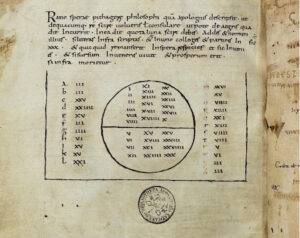
Fig. 2 and 3: Vatican, Pal. lat. 235, fol. 39v Vatican, Pal. lat. 1449, fol. 146v (illness lunaries and spheres of life and death, as referenced in the presentations)
The papers ended on a light note, with van Renswoude introducing an image found in a tenth-century manuscript (Brussels, KB 10066-77), one depicting a sick patient being shown a caladrius bird as a means to prognosticate the course of an illness. This is the very scene mocked in the famous Theodoric Barber of York sketch from Saturday Night Live – if you’re not familiar, see below!
Following Leeds, the CEMLM team made their way to St. Andrews, where they held a two-day meeting to talk through projects already underway and to plan for the future. The exciting news is that the Handlist is slowly but surely moving toward completion. We all hope that you – our blog readers – will be able to view a beta version of it by the end of 2024!