Jeff Doolittle writes…
Happy New Year! After a brief sojourn to the Bodleian Library to discuss Oxford MS Bodl. 232, we are going to jump back to the European continent for our first ‘Manuscript of the Month’ post for 2024. This month, I’d like to introduce a fascinating Beneventan medical manuscript in Vienna, Österreichische Nationalbibliothek, cod. 68.[1] This manuscript may have contained much more material at both the beginning and the end. Unfortunately, there are no signatures or quire markings in the manuscript to help in our assessment, though we can extrapolate some missing contents based on the extant texts. Indeed, what has survived in Vienna ÖNB 68 may just be a remnant of what was a significant early medieval medical miscellany, comprising some of the best theoretical medical texts in Latin along with a carefully planned antidote collection.
Some of the features of this manuscript confounded earlier scholars attempting to date and locate it. Perhaps owing to its daunting Beneventan script, the 1864 Vienna library catalogue dated this manuscript very early to the sixth/seventh century.[2] Then, Valentin Rose, in his edition of Theodorus Priscianus’ Euporiston, dated it quite late, to the eleventh century, seeing its contents as much more in common with later manuscripts. However, further study of the manuscript’s unique style of Beneventan revealed a more precise dating in the late tenth century, as the great paleographer E. A. Lowe suggested.[3]The manuscript is usually described as a product of the monastery of San Vincenzo al Volturno, based on a marginal note in a contemporary Beneventan hand identifying a certain physician Ursus and a church of Sancti Vincentii to which this book was given (see image 1). The community of San Vincenzo al Volturno itself was displaced for much of the ninth and tenth centuries, which makes this uncertain. Moreover, Giulia Orofino and others have suggested a Neapolitan origin for it, based on its script and decorative style.[4]

This manuscript at present contains 102 folios. Vienna ÖNB 68 features an extract of Theodorus Priscianus’ Euporiston (fols. 1r-7v) as well as texts usually known as Liber Aurelii (fols. 7v-22r) and the Liber Esculapii (fols. 22r-72r). The rest of the manuscript contains mainly pharmaceutical recipes (fols. 72r-102v).[5]
At the beginning of the manuscript, we can surmise that at least three missing books preceded what is now the first extant text. Each of the first three texts in the manuscript is attributed to ‘the physician Galen, that is, the most learned doctor’ (Galieni archiatres idest medics peritissimus/sapientissimus). But the first text, the collection of ‘cheap and easy remedies’ (Euporista) attributed to Theodorus Priscianus, is identified in the manuscript as ‘Book IV of the learned Galen’. The two following texts in the manuscript, Liber Aurelii (which is actually a copy of the fifth-century Caelius Aurelianus’ De morbis acutis) and the Liber Esculapii (Caelius Aurelianus’ De morbis chronicis) are each labeled as Book V and Book VI of Galen, respectively.[6]

Books I through III of Vienna ÖNB 68, now unfortunately missing, were likely also attributed to the great physician, and may have included Books I and II of Galen’s Ad Glauconem de medendi methodo and the pseudo-Galenic Liber Tertius, a collection found widely in other manuscripts. For example, two other Beneventan manuscripts, including the ninth-century Montecassino, Archivio dell’Abbazia, cod. 97 and the eleventh-century Città del Vaticano, Bibl. Apostolica Vaticana, Barb. Lat. 160 each contain much the same assemblage of texts in what David Langslow calls the ‘Pre-Gariopontean Ensemble’.[7] This early medieval medical teaching compendium includes extracts of Galen’s De medendi methodo, the Liber tertius, as well as the Liber Aurelius and the Liber Esculapius.[8]
In a similar way, there may have been a bit more material at the end of the manuscript, though here we are admittedly on shakier ground. Recipes fill the leaves from f. 72r to the end of the manuscript on f. 102v, but this is not a random compilation. Instead, this is a well-organized antidote collection, introduced with a dramatic initial A (see image below) and categorized quite rigorously by type of therapeutic compound. Each new preparation is given a large initial filled with color, and on each page, the artist chose a new style for the initials giving the whole section a cohesive aesthetic. After a large antidote section, the collection includes electuaria, eligmata, emplastra and epithimata. This may have been the end of the collection, but I am struck by the careful and ambitious way that this section was laid out. I cannot help but think that there were other similarly-arranged sections devoted to other types of medical preparations, including malagmata, unguenta, cataplasms and the like.

This recipe collection contains yet further surprises. As in many other recipe collections, specialized preparations are sometimes attributed to classical figures such as Alexander of Macedon or Ptolemy, or famous physicians like Galen. But in three recipes found among Vienna ÖNB 68’s collection of antidotes, individuals are cited who look to have been local Beneventan or Neapolitan physicians.
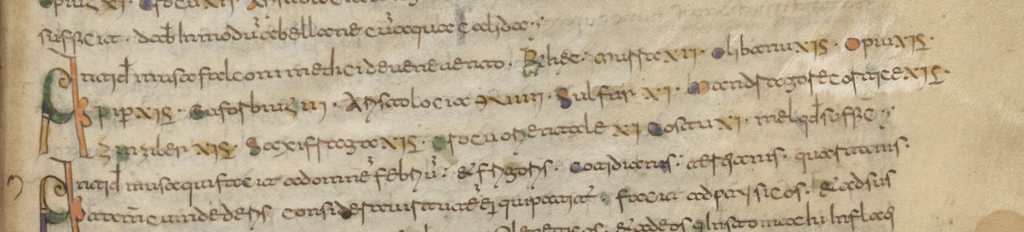
In the first example, an Antidotum musa is ascribed to the medicus Falconus, said to be of Benevento.
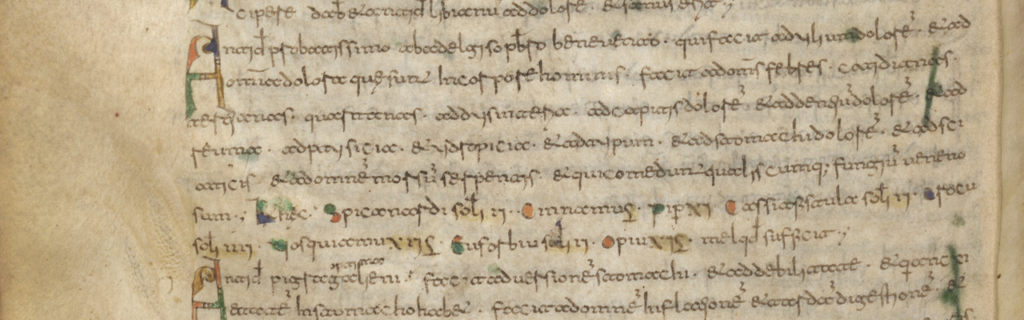
In a second, an Antidotum probatissimo is said to be of Adelgisus presbiter, also from Benevento.
Finally, in the third, an Antidotum mirificum for gout was said to be “dictated” or perhaps “ordered” (dictauit) by Palumbus electus of Naples:

The recipes themselves are not much different from the others around them, whether in terms of indications or ingredients, so what does it mean that at least three different local Beneventan and Neapolitan medical practitioners are named in an ambitious collection antidote collection? The local medical practitioners are attached to recipes that fit broadly within the Greco-Roman medical tradition, and perhaps even more significantly, their preparations are treated at the same level as other authorities named in recipes here, such as Galen and Rufinus. Importantly, these local physicians do not shy away from exotic ingredients such as frankincense and cinnamon. Also, each local practitioner is further identified with a title, perhaps to help establish the source of their authority. Falconus is described as a physician (medicus), Adelgisus is a presbyter, and Palumbus is described as electus or “chosen”. Finally, the Antidotum mirificum ad podagram is described as a recipe that was dictated (quod dictauit) by Palumbus, which suggests both a local physician as well as a student, who at some point copied a favorite remedy that his teacher had once used.
If you’d like to read more about Vienna ÖNB 68 and other Beneventan medical manuscripts, be sure to check out my forthcoming article “Early Medieval Medicine in the Beneventan Zone,” in the Brill Companion to the Beneventan Zone, edited by Andrew J.M. Irving and Richard Gyug.
[1] See a digitized version of Wien, Österreichische Nationalbibliothek, Cod. 68 at: http://data.onb.ac.at/rec/AC13951080. All images from this digitization.
[2] Tabulae codicum manu scriptorum: praeter graecos et orientales in Bibliotheca Palatina Vindobonensi asservatorum, Edidit Academia Caesarea, Vindobonensis, Vol. I: Cod. 1-2000 (Wien, 1864).
[3] E. A. Lowe, Scriptura Beneventana; Facsimiles of South Italian and Dalmatian Manuscripts from the Sixth to the Fourteenth Century (Oxford, 1929).
[4] Giulia Orofino, “Terra Sancti Vincencii e Terra Sancti Benedicti: Miniature oltre i confini,” in Il Molise medieval: Archeologia e arte, ed. Carlo Ebanista e Alessio Monciatti (Firenze, 2010), pp. 201-9 at 202.
[5] Augusto Beccaria, I codici di medicina del periodo presalernitano (secoli IX, X e XI), (Roma, 1956), pp. 106-8.
[6] Guy Sabbah, Pierre-Paul Corsetti and Klaus-Dietrich Fischer (eds.), Bibliographie des textes médicaux latins: Antiquité et haut moyen âge (Saint-Étienne: 1987); see pp. 43-47 (Caelius Aurelianus) and p. 81 (Esculapius).
[7] David Langslow, The Latin Alexander Trallianus: The Text and Transmission of a Late Latin Medical Book (London, 2006).
[8] Whereas all the surviving texts in Wien 68 are attributed to Galen, the books of the Cassinese manuscript are given separate authors (Galen, Aurelius and Esculapius); in the Vatican manuscript, a marginal note of slightly later date than the main hand attributed all of these texts to Dioscorides.